
Best Car Insurance for Different Driver Profiles in 2026
Compare top providers to find the right coverage for your profile

 Safe & Secure
- Accurate. Real-time quotes










Cheapest recent car insurance quotes
Drivers across the United States have found policies from Just Unlimited, Bristol West, Mercury, and more, through Affordable Plans in the last few days.
Quick Facts
Affordable Plans is a licensed insurance agency in all 50 states
Comparing quotes can save up to 30%
Great idea after major life events
Car insurance premiums vary significantly from one driver to another, as no two drivers face the same risks on the road. For example, a teen driver with little experience will typically face much higher rates than an experienced driver. Similarly, a college student living far from home may encounter different rates compared to a parent with years of safe driving. These differences arise because insurers take multiple factors into account when calculating premiums.
Insurance companies consider a range of factors such as your age, driving record, the miles you drive, and even your location when determining how much your coverage will cost. Teens and young adults generally pay higher premiums due to their inexperience and higher risk of accidents. Conversely, experienced drivers with a clean record can often access lower premiums due to their demonstrated responsibility on the road.
In this guide, we’ll dive deeper into the most common driver profiles and explain how rates fluctuate based on each. We’ll also help you understand what type of coverage makes the most sense for your unique situation, share tips on how to lower your premium, and offer guidance on how to select a policy that strikes the perfect balance between protection and price.
How Car Insurance Works in the U.S.
Car insurance rates are determined based on a variety of factors, all aimed at estimating your risk as a driver. Insurers consider personal details, driving history, and local regulations to calculate your premium. These factors explain why your rate may differ from someone else’s, even if you drive the same car.
Some of the main things they consider include:

Driving Record
Accidents, speeding tickets, or DUIs increase your risk, leading to higher premiums. For example, a DUI can double your rates in some cases.
Experience
New and young drivers typically pay higher premiums due to their inexperience. Experienced, safe drivers usually enjoy lower rates.
Mileage
The more you drive, the higher the chance of an accident. Low-mileage drivers may qualify for discounts of 15-20%.
Vehicle Type
High-performance or luxury vehicles cost more to insure due to higher repair costs. Standard vehicles tend to have lower premiums.
Location
Urban areas with heavy traffic and higher theft rates lead to higher premiums, while rural areas tend to have lower rates.
Each state also sets its own rules:
Minimum coverage limits vary, and many states are raising them
Some states require PIP (Personal Injury Protection) under no-fault laws
A few states ban the use of credit scores or gender when setting rates
Did You Know?
In California, car insurers are not allowed to use credit scores or gender to calculate your premium. They must focus on your driving record, mileage, and years of experience instead.
Car Insurance for Different Driver Profiles
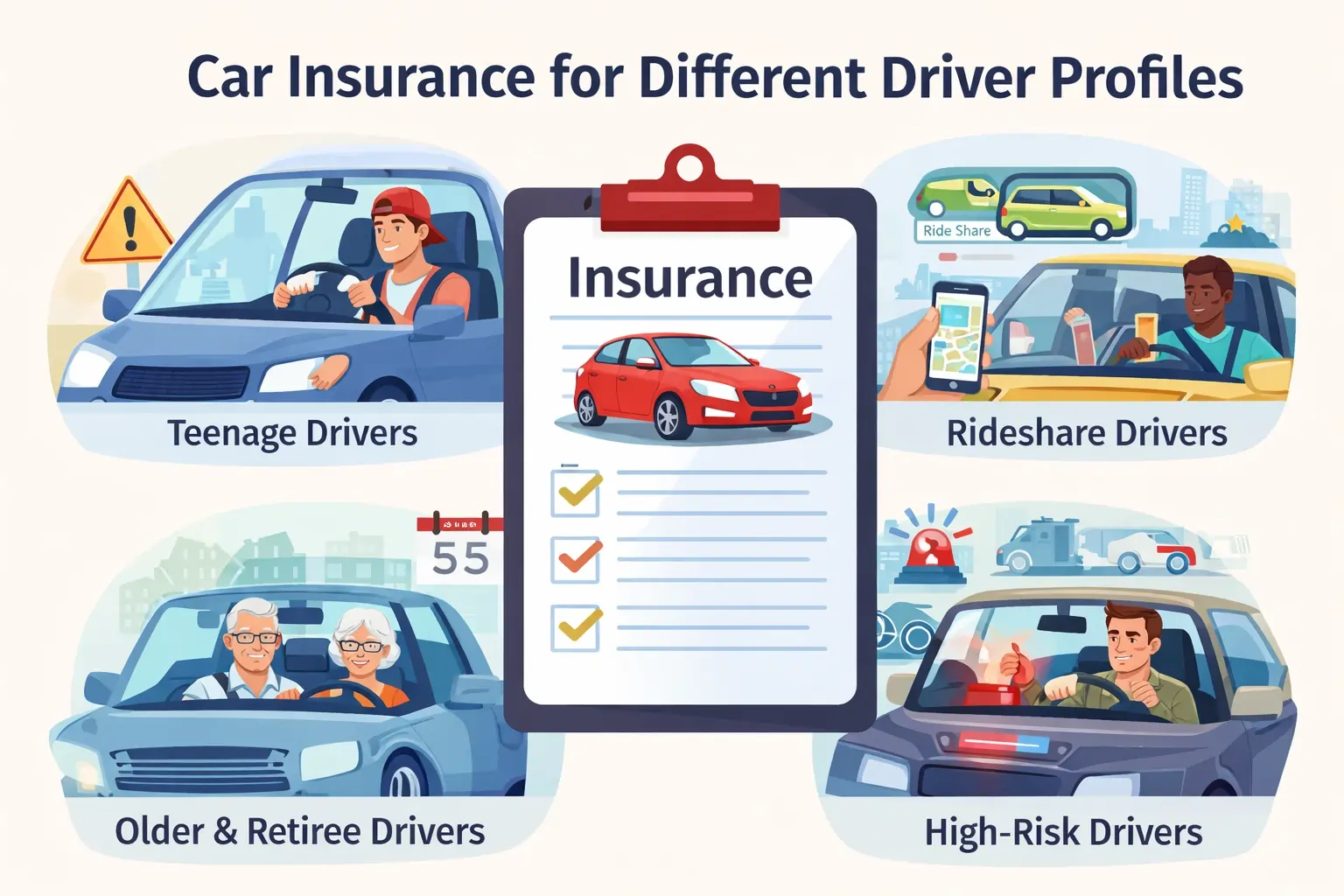
Not every driver faces the same risks, and that’s why insurance costs are different for each group. A teen driver who just got their license, a rideshare driver who is on the road all day, or a retiree who only drives once a week each one falls into a profile that shapes their price and coverage needs.
Understanding the driver profiles that influence your insurance rates is key. Whether you’re a teen driver or a frequent driver, knowing what factors impact your premium can help you make informed decisions about coverage and costs.
1. Teen & New Drivers
Teen drivers typically pay the highest premiums because they are still gaining experience on the road. Statistically, young drivers are more likely to be involved in accidents, which makes them higher-risk customers for insurers. According to the National Highway Traffic Safety Administration (NHTSA), teen drivers have a four times higher crash risk compared to adult drivers.
Quick Tip: Teens who complete driver’s education often qualify for lower rates.
2. College Students & Young Adults
While college students may not be on the road as frequently as other drivers, their insurance premiums can still be quite high. Young drivers who are away from home, especially if they don’t have a car with them, may be able to take advantage of some special discounts that can help lower their rates.
Quick Tip: Students with a GPA of 3.0 or higher often qualify for discounts.
Compare Car Insurance Online
Find out how much you could save on car insurance today.



3. Safe & Low-Mileage Drivers
Drivers with clean records and fewer miles behind the wheel are typically considered to be lower risk, which often translates into lower premiums. Insurers take into account the frequency and nature of driving, so safe, low-mileage drivers are often rewarded with discounted rates. If you're someone who drives infrequently, or you maintain a clean driving record, you're likely to pay less for coverage.
Quick Tip: Low-mileage drivers can save hundreds each year with pay-per-mile insurance.
4. High-Mileage Commuters
High-mileage commuters often face higher insurance premiums due to the increased exposure to risk. The more time you spend on the road, the higher the likelihood of being involved in an accident. Insurance companies consider this factor when calculating rates, as drivers who commute long distances are statistically more likely to file a claim.
Quick Tip: Even if you drive a lot, smooth and careful driving can help lower telematics-based rates.
5. High-Risk Drivers (Accidents, Tickets, DUIs)
High-risk drivers are those who have a history of violations, accidents, or other driving issues like DUIs. Because of their increased likelihood of being involved in another accident, they tend to pay significantly higher premiums. Drivers with violations or accidents on their records may see their rates increase by 20% to 100% depending on the severity of the issue.
Quick Tip: A DUI can nearly double your insurance cost, but rates may improve after three to five years of clean driving.
6. Rideshare & Delivery Drivers
Rideshare and delivery drivers those working for platforms like Uber, Lyft, or food delivery apps-often face unique insurance challenges. Personal auto policies typically don't cover incidents that occur while you're 'on the job,' meaning that if you're driving for work and get into an accident, your personal policy may not cover the damages. This is why rideshare drivers need special coverage.
Quick Tip: Without a rideshare endorsement, personal claims may be denied if the accident happened while working.
7. Older Drivers & Retirees
As drivers get older, they often benefit from years of safe driving, which can lead to discounts with some insurers. However, despite their safe track record, seniors may still face higher premiums as they age due to factors like decreased reflexes or health-related issues that could increase their risk on the road. This is a common trend in the industry, where insurance costs tend to rise for drivers aged 65 and older.
Quick Tip: Many insurers offer discounts for drivers over 55 who complete a safe driving course.
8. Military Members & Families
Military families often face unique circumstances, and that’s why many insurers, including USAA, offer specialized policies and discounts tailored to military drivers. Whether you’re on active duty or a veteran, you may qualify for discounts and policies that reflect your service.
Quick Tip: Many companies cut premiums if your car is stored on base during deployment.
9. Electric Vehicle (EV) Owners
Electric vehicles (EVs) have become increasingly popular due to their environmental benefits and advanced technology. However, insuring an EV can be more expensive than insuring a traditional car. This is primarily because the cost of repairing or replacing batteries and parts specific to electric vehicles can be quite high. According to a Consumer Reports study, the cost of repairing an EV can be 40% higher than repairing a standard vehicle due to expensive parts and limited repair options.
Quick Tip: While EV repairs may cost more, many companies offer discounts for environmentally friendly vehicles.
10. Classic & Collector Car Owners
Owners of classic cars or collector vehicles face unique insurance needs. Unlike regular vehicles, the value of a classic car often appreciates over time, especially if it’s well-maintained and in demand. However, this also means that traditional auto insurance policies don’t always provide the necessary protection. Classic cars require specialized coverage to ensure they’re adequately protected.
Quick Tip: With agreed value insurance, you and your insurer decide the car’s value ahead of time, so there’s no debate if it’s totaled.
11. Drivers New to the U.S.
For new immigrants and international students, securing car insurance in the U.S. can be more expensive, especially if they don't have a previous driving history in the country. Insurance companies rely heavily on driving records to assess risk, so if you lack a U.S. driving history, insurers often treat you as a higher-risk driver, which results in higher premiums.
Quick Tip: Some insurers will accept international driving experience to help lower your starting rate.
12. Drivers with Poor Credit
In many states, credit history plays a significant role in determining your car insurance premiums. A poor credit score can lead to higher premiums, as insurers often view drivers with low credit as higher-risk customers. According to the Federal Trade Commission (FTC), drivers with poor credit can pay up to 50% more for insurance compared to those with good credit.
Quick Tip: States like California, Hawaii, and Massachusetts do not allow insurers to use credit scores when setting auto insurance rates.
Comparison of Car Insurance by Driver Profile (2026 Averages)
| Driver Profile | Avg. Annual Premium (USD) | Key Risks Considered | Typical Coverage Needs | Common Discounts / Savings |
|---|---|---|---|---|
| Teen & New Drivers | $4,500 – $6,000 | Inexperience, high crash risk | Higher liability, collision, comprehensive, UM/UIM | Good student (up to 15%), driver’s ed (5–10%), telematics |
| College Students & Young Adults | $2,500 – $3,800 | Age, miles driven, location | Liability, collision if car on campus, PIP/MedPay | Away-at-school (10–20%), good grades (up to 15%), multi-car |
| Safe & Low-Mileage Drivers | $1,300 – $1,800 | Fewer miles, clean record | Standard liability, collision, UM/UIM | Pay-per-mile (10–30%), safe driver apps, bundling |
| High-Mileage Commuters | $1,900 – $2,500 | More road exposure | Higher liability, UM/UIM, rental & roadside | Telematics safe driver (5–15%), multi-policy |
| High-Risk Drivers (DUI, tickets) | $3,800 – $6,500 | Past violations, DUI, SR-22 | State minimum or higher liability, SR-22/FR-44, non-owner if no car | Defensive driving course (5–10%), compare high-risk insurers |
| Rideshare & Delivery | $2,400 – $3,200 | Commercial use, long hours | Rideshare endorsement, collision, liability | Rideshare-specific policies, mileage tracking |
| Older Drivers & Retirees | $1,500 – $2,200 | Age-related risks, medical costs | Liability, medical coverage (PIP/MedPay), optional collision | Mature driver course (5–15%), low-mileage, bundling |
| Military Members & Families | $1,400 – $1,900 | Deployment/storage, frequent moves | Liability, comprehensive for storage, flexible coverage | Military discounts (up to 15%), storage discount (up to 60%) |
| Electric Vehicle (EV) Owners | $2,000 – $3,000 | Battery/repair costs | Liability, collision, comprehensive, OEM parts | EV discounts (5–10%), eco-friendly perks, bundling |
| Classic & Collector Owners | $800 – $1,500 | Rare use, collectible value | Agreed value policy, comprehensive, storage | Garage storage (10–20%), limited mileage policies |
| Drivers New to the U.S. | $2,200 – $3,200 | Limited driving history | Basic liability, collision, proof of insurance | International license acceptance, move to standard rates in 6–12 months |
| Drivers with Poor Credit | $2,500 – $3,800 | Credit-based risk scoring (where legal) | Liability, collision if financed | Telematics (5–15%), bundling, continuous coverage |
Key Insight: Teen drivers pay the most on average (over $4,500 per year), while safe, low-mileage drivers and classic car owners often pay the least (under $1,500 annually). Discounts can reduce premiums by 10–30%, depending on the profile and insurer.
Compare Car Insurance Online
Find out how much you could save on car insurance today.
Coverage Needs by Profile
Every driver needs car insurance, but the type of coverage varies greatly depending on individual factors like your driving habits, the type of car you drive, and your overall risk level. For example, a teen driver has different coverage needs compared to someone who drives a classic car or an electric vehicle. Similarly, a commuter who drives long distances daily will require different coverage from someone who rarely drives. Below, we’ll break down the essential types of car insurance coverage, their benefits, and which drivers typically benefit from them.
Liability Insurance
Pays for injuries or property damage you cause to others
Best for: All drivers but teens, high-risk drivers, and commuters should consider higher limits (100/300/100 instead of just state minimums)
Collision Coverage
Pays to repair or replace your car after an accident
Best for: Teens, college students, EV owners, and anyone with a financed or leased car
Comprehensive Coverage
Covers theft, fire, vandalism, weather damage, or hitting an animal
Best for: EV owners, classic car owners, and high-risk areas with storms or theft
Uninsured/Underinsured Motorist (UM/UIM)
Protects you if the other driver doesn’t have enough coverage
Best for: High-mileage commuters, teens, and safe drivers who want peace of mind
Personal Injury Protection (PIP) or Medical Payments (MedPay)
Helps with medical costs after an accident, no matter who is at fault
Best for: Drivers in no-fault states, older drivers, and college students away from home
Gap Insurance
Covers the difference between what you owe on your car loan/lease and the car’s value after a total loss
Best for: New car buyers, EV owners, and anyone leasing a vehicle
Rideshare Coverage
Fills gaps not covered by Uber, Lyft, or delivery apps
Best for: Rideshare and delivery drivers
Agreed Value Coverage
Pays the full insured value of a classic or collector car if it’s totaled
Best for: Classic and collector car owners
Discounts & Savings Opportunities
Car insurance companies offer various discounts to help reduce your premium. Whether you're a safe driver, a student, or a military member, there are ways to save money on your policy. Understanding the most common discounts available and who qualifies for them can help you make informed decisions and reduce your car insurance costs.
| Discount Type | Who Qualifies | Avg. Savings % |
|---|---|---|
| Good Student | High school or college students with GPA 3.0+ or honor roll | 10–15% |
| Defensive Driving Course | Drivers who complete an approved safety class | 5–10% |
| Multi-Car | Families or households insuring more than one vehicle | 8–15% |
| Bundling (Auto + Home/Renters) | Drivers combining auto with another policy | 10–25% |
| Usage-Based / Telematics | Safe drivers who allow driving behavior tracking | 10–30% |
| Pay-in-Full | Drivers paying the 6- or 12-month premium upfront | 5–10% |
| Auto-Pay & Paperless | Drivers setting up automatic payments or e-billing | 3–5% |
| Military & Deployment | Active duty, veterans, and families | 10–15% (up to 60% for storage) |
| Low-Mileage / Storage | Drivers who drive less or store their car long-term | 5–20% |
Quick Tip: Stacking discounts matters. A family with a teen driver could combine good student, multi-car, bundling, and safe-driving program discounts to cut costs by 25–35%.
State-by-State Variations
Car insurance is not the same everywhere in the U.S. Each state sets its own rules for minimum coverage, whether no-fault laws apply, and what factors insurers can use to calculate rates. Knowing these differences can help you understand why your premium may be higher or lower than someone in another state.
| State Example | Minimum Liability Limits (as of 2025) | Credit Use in Pricing | Gender Use in Pricing | No-Fault / PIP Requirement |
|---|---|---|---|---|
| California | 30/60/15 (raised in 2025) | ❌ Not allowed | ❌ Not allowed | Tort system (no PIP) |
| Florida | 10/20/10 + $10k PIP | ✅ Allowed | ✅ Allowed | ✅ No-fault (PIP required) |
| Michigan | 50/100/10 + Unlimited PIP option | ❌ Not allowed | ✅ Allowed | ✅ No-fault (PIP required) |
| New York | 25/50/10 + $50k PIP | ✅ Allowed | ✅ Allowed | ✅ No-fault (PIP required) |
| Hawaii | 20/40/10 + $10k PIP | ❌ Not allowed | ❌ Not allowed | ✅ No-fault (PIP required) |
| Texas | 30/60/25 | ✅ Allowed | ✅ Allowed | Tort system (no PIP, MedPay optional) |
| Massachusetts | 20/40/5 + $8k PIP | ❌ Not allowed | ❌ Not allowed | ✅ No-fault (PIP required) |
✅ Key takeaway: In some states (like California, Hawaii, and Massachusetts), insurers cannot use credit scores or gender at all when setting rates. In no-fault states (like Florida, Michigan, and New York), Personal Injury Protection (PIP) is required, which can raise premiums but ensures faster medical payouts.
How to Choose the Right Policy
Use this checklist to make sure you’re choosing a policy that fits your needs, not just the lowest price.
Get at least 3 quotes: Compare offers from different insurers before deciding.
Match coverage to your profile: Teens may need higher limits, while low-mileage drivers can save with pay-per-mile options.
Check your state rules: Make sure your policy meets minimum requirements and covers no-fault or PIP if required.
Look for discounts: Ask about bundling, safe driver programs, student savings, or military benefits.
Review coverage after life changes: Moving, buying a car, or changing jobs can affect your insurance needs.
Avoid bare-minimum coverage: Stronger protection, like 100/300/100 liability, often saves money in the long run by covering big accidents.
Expert Insights
We asked insurance specialists and industry reports what drivers should know before choosing coverage. Here are some of the top insights:
On coverage limits:
The state minimums are often too low. One serious accident can cost far more than the legal minimums cover, so aim higher if you can.
– Insurance Analyst, III
On teen drivers:
The best way to manage teen driver costs is to add them to a parent’s policy and use every discount available from grades to safe driving apps.
– Licensed Agent, Allstate
On safe driving habits:
Telematics programs are changing the game. Careful driving can lead to 20–30% savings for many customers.
– Consumer Insurance Report, 2025
On EV insurance:
Repair costs for electric vehicles are higher, but some insurers now offer eco-discounts to encourage adoption.
– Market Study, 2025
On shopping for policies:
Never accept the first quote. Comparing at least three insurers can save drivers an average of $500 a year.
– Policy Research Group
Frequently Asked Questions
Because they are new drivers with little experience, teens are more likely to be in accidents. This makes them a higher risk for insurers.
Yes. In fact, it’s usually cheaper to stay on a parent’s policy. If you live away from home without a car, you may even qualify for an “away-at-school” discount.
Minimum coverage only meets your state’s legal requirements, often just liability. Full coverage usually includes liability, collision, and comprehensive, which protects both you and your car.
No. States like California, Hawaii, Massachusetts, and Michigan do not allow credit scores to be used when setting auto insurance rates.
You can take a defensive driving course, use a telematics program to prove safe driving, and shop with insurers that specialize in high-risk drivers. Over time, a clean record will lower your rates.
Not always. EVs can cost more to insure because repairs and batteries are expensive. However, some insurers now offer eco-friendly discounts.
At least once a year, or whenever you have a major life change — like moving, buying a new car, or adding a new driver.